The NBA Cup Has Real Stakes and the Thunder’s Upset Opened the Door for Everyone
The NBA has spent the last handful of years experimenting with ways to shape its calendar into something that feels louder, cleaner and more intentional. Some of those ideas have landed with a thud. Others have felt like solutions in search of a problem.
One of the implementations that has actually gained real traction, though, is the Emirates NBA Cup, now in its third season. And the concept isn't overly complicated. It simply asks them to care a little more about games that already exist.
The genius of the NBA Cup is how familiar it feels while still introducing something different. It borrows from what has long worked in European soccer, which is an in-season tournament structure that runs parallel to the normal grind. You still get standard NBA rules, standard rotations, standard play styles. But you also get a group stage, you get knockout rounds, and you get a championship game with a bracket behind it. It gives the regular season something it’s often missing early, bringing a straightforward sense of consequence that doesn’t require a months-long standings watch or a trade-deadline drama cycle to kick in.
That matters because the league has battled an attention problem in the fall for years. The NBA is not a niche product. The stars are huge, the social footprint is enormous, and the sport lives on every screen. But the reality is that football sits on top of the sports calendar from September through the end of the year. For the average fan, the pivot to basketball tends to happen later, when college football wraps and the NFL shifts into its playoff runway.
The NBA Cup is designed to pull some of that attention forward. Group Play sits in November, when the season is still young and the broader sports world is still fully in football mode. Then the tournament phase hits in December, when people are ready for something that feels like an event. It’s a calendar solution, and it’s a product solution at the same time.
It’s also simply better basketball. Part of what makes Cup Nights feel different is that teams have incentives to keep competing even when a game looks decided. Group Play tiebreakers reward point differential, which has changed how teams play late in games. You see coaches resist the instinct to coast. You see starters and key rotation guys stay engaged a little longer, because they care about the margin, not just the win. That small tweak has created a noticeable edge without the league needing to artificially inflate intensity with rule changes or gimmicks.
Now the NBA Cup is down to its simplest form All that remains is one game for the trophy. The championship is set for Tuesday in Las Vegas, Nevada, with the New York Knicks representing the Eastern Conference and the San Antonio Spurs representing the Western Conference. The Knicks are currently 2.5-point favorites according to BetMGM, meaning this one could go down to the wire.
A neutral site matters here, too. It turns the end of this into a true standalone moment. It’s not just a big regular-season game that happens to have extra marketing attached. It’s a destination game in a destination city, with two teams arriving on the same stage and the same schedule.
It’s also an unusual game in the context of the NBA calendar. While most NBA Cup games count as regular-season games, the championship does not count toward a team’s record. It’s essentially an 83rd game for both teams, which is part of what makes it feel separate. If you’re a fan who cares about standings and stats, the league has tried to keep the competitive integrity of the regular season intact. If you’re a fan who cares about moments and stakes, the league has created one more place for those moments to exist.
And the stakes are real. The financial prize for players is significant, and while half a million dollars per player might not change life for the league’s highest-paid superstars, it absolutely matters for the middle and back end of a roster. It matters for the guys playing real minutes who aren’t on max deals. It matters for the role players, the specialists, the bench pieces who are fighting to hold their place in the league. Money is only part of it, but it’s a meaningful part of it. Add in the trophy, the banner in the home arena of the winner, and the individual recognition that comes with a tournament MVP, and you get a package of incentives that can actually move the needle in a league where it’s hard to create urgency outside of the playoffs.
The path to this final has felt like the NBA Cup at its best. The Knicks reached the championship game by taking down the Orlando Magic in the semifinals with a high-powered performance led by Jalen Brunson, who dropped 40 and turned a big moment into his personal stage. That kind of game is exactly what the NBA is trying to bottle in December, with a star having a signature night in a setting that feels bigger than the normal schedule.
On the other side, the Spurs reached the final by beating the Oklahoma City Thunder in a two-point semifinal that changed the tournament’s storyline in one swing. That Thunder loss is the hinge point of the entire NBA Cup this season. Oklahoma City had been the clear favorite in terms of narrative and in terms of expectation. The Thunder has looked like the league’s most complete team, and this tournament felt like it was setting up for Oklahoma City to steamroll its way into the final, given the Thunder was 24-1 entering the matchup against the Spurs. Shai Gilgeous-Alexander, by extension, had been positioned as the likely tournament MVP if the Thunder did what people expected the Thunder to do. That wasn’t just a betting market reflection. It was a storytelling reflection. OKC felt inevitable, and Shai felt like the face of inevitability.
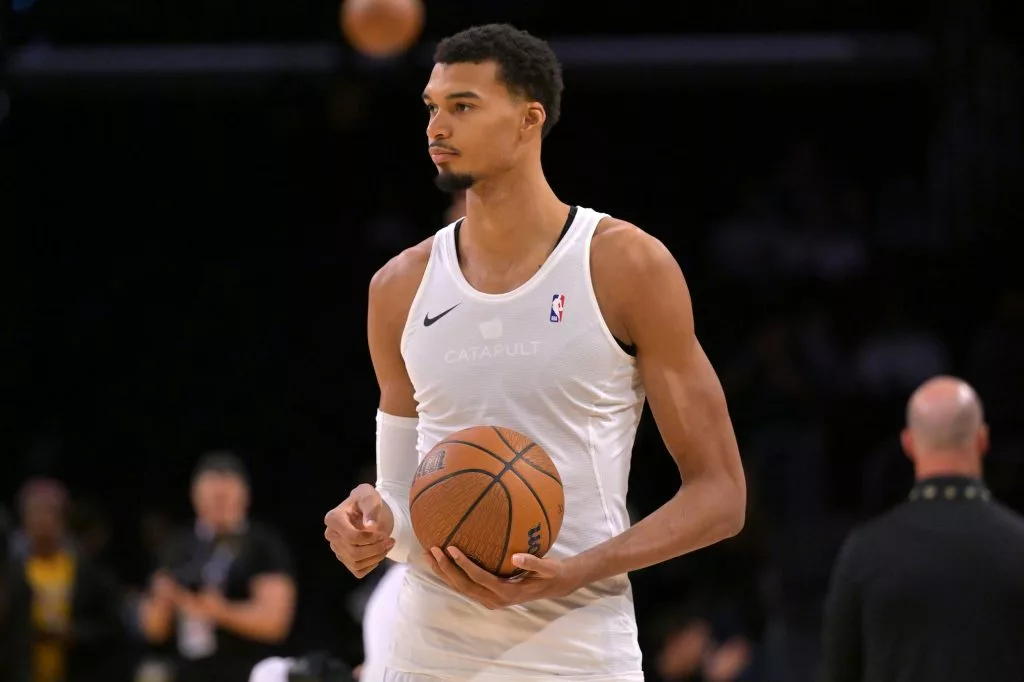
Then the tournament did what tournaments do. Single elimination doesn’t care about your season-long profile. It cares about one night, one set of matchups, one set of bounces, one stretch of execution. The Spurs knocked out the Thunder 111-109, and Victor Wembanyama’s return from injury gave the game a gravitational pull it wouldn’t have had otherwise. That result didn’t change who the Thunder is long-term, but it completely changed what the NBA Cup is right now.
The favorite is gone. The presumed MVP front-runner is gone. The final became a true coin flip in terms of narrative, and the awards are now truly up for grabs. As of now, Bet365 has Jalen Brunson as the favorite to win NBA Cup MVP (-115), with Victor Wembanyama (+450) and De'Aaron Fox (+500) next in line.
That’s a win for the league. Parity is a great thing in this era, and the NBA has increasingly felt like a parity league at the championship level. There hasn’t been a repeat NBA champion in years. Teams rise, teams fall, and the league’s competitive balance creates new storylines every spring. The NBA Cup is mirroring that same reality in a condensed form. The Lakers won the inaugural tournament. The Bucks won last season. Now, one of the Knicks or Spurs will win this season, and the tournament will again produce a fresh champion and a fresh memory instead of feeling like the same script on repeat.
The most fascinating part of Tuesday’s championship is how many different outcomes feel plausible. New York has the bigger-market spotlight, a roster that can score in bunches, and a lead guard who has shown he can dictate the rhythm of a game when the pressure ramps up. San Antonio has the league’s most unique defensive presence in Wembanyama, a roster that is clearly growing into itself, and the kind of “nothing to lose” edge that can be powerful in a one-game setting. The Cup doesn’t need this to be a dynasty moment. It needs this to feel like a moment, period.
There will always be details to tweak. Scheduling will continue to be refined. The neutral-site approach will always invite debate. The league will keep searching for the cleanest way to make the Cup feel integrated without feeling intrusive. But the bigger truth is already clear: the NBA Cup has created meaningful December basketball in a way that the regular season alone rarely does. It has pulled attention forward, sharpened competitiveness, and built a second championship-like stage into the calendar without compromising the sport itself.
On Tuesday night in Las Vegas, the league gets its payoff, with a trophy game that feels like an event, a new champion guaranteed, and a tournament that, for a third straight year, has proven it belongs.
-
MLB Home Run Props and Predictions Today: Top Player Props for Sept. 23
-
Presidents Cup Props & Parlay Picks for 2026: Sam Burns Time
-
‘America’s Got Talent’ Finale Prediction Markets: Nene Royal Leads
-
Tribes Line Up to Criticize Tunica-Biloxi Prediction Market Move
-
Guardians vs. Red Sox Prediction, Odds & Props for Sept. 23: Boston Ends Skid
-
Presidents Cup Odds & Predictions for 2026: Good American Chalk