

Explaining How Does Polymarket Work - 2026 Guide
How does Polymarket work is a common question for anyone new to event trading. That’s mostly because the platform looks very different from traditional betting or investing sites at first glance.
At its core, Polymarket lets us trade simple Yes or No contracts on real-world outcomes using crypto. In this guide, we’ll break down how markets are structured, how pricing works, and what moves odds. You’ll also learn how settlements happen and the key risks and strategies to understand before trading.
What is Polymarket – And why it exists
What is Polymarket? It’s a regulated events trading website where you can earn money by predicting outcomes of real-world events. All trading happens in crypto, specifically USDC, but you can deposit in fiat currency, and the site will do the conversion. But how does Polymarket work? The site uses regulated event contracts that participants buy and sell as a way to speculate on future outcomes.
How event contracts are structured
You can’t explain what Polymarket is without describing event contracts. Put simply, you buy a Yes or a No contract based on whether you believe a specific event will occur. Winning contracts are worth $1, and losing ones, nothing ($0). Contracts are active for as short as 5 minutes to as long as multiple years, and positions resolve within 2 hours after event settlement.
How prices reflect probability
To better appreciate how to trade on Polymarket, understand that contracts are priced between $0.01 and $0.99. The contract price reflects what the crowd believes is the likelihood of an event happening. For instance, $0.65 implies a 65% chance of the event occurring. Traders determine prices, which means that they change directly with sentiment. Market confidence in a particular event happening changes anytime new information is brought to light, causing the price to rise or fall. Extreme price fluctuations are to be expected around events like elections.
What moves prices in a market
Breaking news is a core catalyst for instant price shifts in prediction markets. If traders learn new information, they’ll buy Yes or No outcomes right away based on how they feel this news will affect the outcome. The same logic applies to data releases and political developments, and prices are updated in real time. Major price shifts also often occur when large traders, known as “whales,” enter positions. These traders often have specialized knowledge that guides them to execute large trades, significantly shifting the price toward the final outcome.
Buying and selling before market resolution
Traders can buy or sell contracts before the market officially closes instead of waiting for the final result. As long as a trade is active, it’s liable to price shifts due to changing sentiments. When you close your position early, you lock in profits or losses, depending on the result. You, however, need to consider the number of participants, as this affects the price gap between buyers and sellers (bid-ask spreads).
Types of events you can predict on Polymarket
When explaining what Polymarket is and how it works, we need to cover the different markets. Traders can predict outcomes on pretty much anything, from finance to crypto prices.
Economic and financial events
Binary outcomes for economic and financial markets usually center on inflation reports, interest rate decisions, GDP releases, and unemployment figures. A typical question here would be, “What will Tesla Inc hit in May 2026?” You’ll do well to follow economic trends and be on top of official data releases. Bear in mind that the prices move based on changing expectations, even before results are announced.
Weather and environmental events
You can predict weather forecasts with this market. It covers temperature records, storm activity, rainfall levels, and other measurable weather outcomes. Something as simple as correctly guessing the “highest temperatures in Paris on May 12” can earn you some real bucks. As frivolous as this niche seems, markets are based on objective, trackable data sources. You need insight into forecasts, seasonal trends, and expert models because they’re the primary price drivers and influence trader expectations.
Political and policy events
Users can level their political knowledge for real cash. You predict election outcomes, such as the Presidential winner in 2028. In fact, US Polymarket election markets are often the most active, involving billions of dollars. Approval ratings also fall here. In this case, you answer a question like “Will Biden’s approval be above 50% in June? Legislation and policy decisions are also covered here. Traders need to analyze public polling, news cycles, and political developments as they influence market pricing.
Culture, science, and headline-driven events
This market lets you predict outcomes for iconic entertainment awards like the Grammys. Technology milestones and major scientific achievements also feature here. You can guess which company has the best AI model by the end of next month. These markets are quite popular because they attract broader public interest, not limited to finance, politics, and economics. However, this is a pretty fickle market where media coverage, public sentiment, and breaking news can quickly shift probabilities.
Crypto and digital asset events
You can predict Bitcoin and Ethereum price milestones, like what price BTC will be by the end of December. News around institutional buying, policy decisions, and market sentiment can affect contract pricing by altering the market’s liquidity. For instance, a tightened monetary policy will lower crypto prices.
| Event category | What users predict | Example |
|---|---|---|
| Economic | Inflation, rates | Will inflation exceed 3%? |
| Political | Elections, policy | Will candidate X win? |
| Weather | Temperature, storms | Will rainfall exceed X? |
| Crypto | BTC/ETH prices | Will BTC hit $100k? |
| Culture | Awards, news | Will a film win an Oscar? |
How to trade on Polymarket
By now, you have a clear idea of what Polymarket is. Now, let’s talk about getting you started on the site. Lucky for you, setting up is quite simple, as explained below.
Account setup and funding
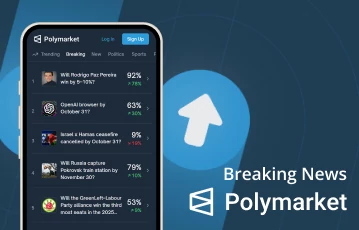
Click the banners on this page to visit the Polymarket website. You can also use your mobile phone if you’re looking to know what the Polymarket app is like.
-
Tap “Sign Up”.
-
Sign up via email or Google.
-
If you opt for email, provide your email address and click “Continue”.
-
Verify the 6-digit code forwarded to your Inbox.
-
Select your preferred username and agree to the operator’s terms of use.
-
Upload a copy of your ID to verify your account.
-
Fund your account using USDC and start trading immediately.
-
Enter your Polymarket referral code if you have one during registration to access any available welcome bonus.
Buying a position
To buy a position, start by browsing the available markets and select an event that grabs your attention. Go on to place an order by purchasing a Yes or No contract, depending on whether you think the outcome will happen. Consider the available price before buying, as it shows your potential profits or losses after the event concludes.
Selling before market resolution
Selling your position before the market closes allows you to lock profits early and hopefully cut losses. The longer a position is active, the more liable it is to price fluctuations based on changing information. In this case, active trading by buying and selling positions quickly will usually benefit you more than holding onto positions until maturity.
Reading order books and liquidity
Predictions markets have what are known as bid and ask prices. The bid price is set by the buyer, and the seller sets the asking price. Shifts in these two prices are largely influenced by the number of people trading in the market, also known as liquidity.
If there are high trading volumes (high liquidity), there will be a small gap between the buyer and seller prices (spreads). This is an ideal scenario that maintains minimal price shifts for profitable trading. Thin markets characterized by low volatility or low trading volumes are undesirable. Even a single position purchase or sale can dramatically shift prices, making it volatile
How Polymarket settles outcomes
How does Polymarket work concerning event settlements? Event contracts settlements follow a clear and decentralized resolution process, as we’ll explain.
How winning shares are paid
Polymarket event contracts either settle at $1 or $0. All winning contracts are settled at full value. So, if you purchase a $0.70 yes contract and the event happens, it’s settled at $1, and you pocket a $0.30 profit. If the outcome goes sideways, you get nothing, and losing shares become worthless.
Who determines the final outcome?
When learning about Polymarket and how it works, you’ll notice it follows an objective settlement process that relies on trusted data sources to determine outcomes. The site is transparent about everything and publishes the resolution criteria alongside respective data sources on the website. You’ll find the criteria on each market page, listed under order book, so everyone is on the same page.
What happens in disputed situations
Contracts settle in 2 hours for undisputed markets. However, delays in settlement can happen if traders aren’t happy with the outcome and challenge it. Such rare edge cases are caused by misinterpretations of event definitions or regulatory intervention. In such instances, this triggers a debate followed by a voting session. Overall, it can take days or weeks for contested markets to reach a consensus.
Fees, costs, and practical trading considerations
How does Polymarket work in terms of fees? The site charges a taker's fee on most of the market trades, but not all. The fee varies based on the contract size and peaks around the $0.50 mark. In such a case, expect to play between 0.75% to 1.8% of the trade.
Polymarket doesn’t charge for deposits or withdrawals, but your crypto exchange might. Since all trading happens in USDC, you pay conversion costs depending on the payment method. For instance, you pay 2% or 3% per transaction if you use a debit/card via MoonPay. Look out for a 2% to 3% execution slippage fee charge calculated on your order size and market liquidity. If you decide to close your position early, it’s easier in active markets with higher liquidity. Also, diversify prediction markets to spread risk and avoid overconfident or emotional trading.
How does Polymarket work pros & cons
Polymarket predictions provide a simple way to make a profit on your knowledge of specific events, but they do carry risk. We’ve rounded up the pros and cons of the Polymarket prediction market and how it works.
- Variety of prediction markets to choose from
- Easy Yes/No outcomes
- Clear contract resolution processes
- Some markets have low liquidity
Predict future outcomes and secure a buck
What does Polymarket do? It’s simply a site where you trade event contracts on future outcomes using simple Yes/No possibilities. If you pick Yes on a $0.30 contract, for example, and the event happens, you make $0.70. If it doesn’t happen, you lose your 30 cents.
Our Polymarket review confirms that this is a decentralized system where peers trade against each other and determine prices. That’s why prices shift based on ever-changing public perceptions. You can close your position early to hopefully lock in profit or hold out a little longer until the event closes. Either way, settlements are resolved clearly and transparently. Click the banners on this page to give Polymarket a try or sign up with the best sites available in your region.