

Explaining How Does Kalshi Work - 2026 Guide
How does Kalshi work is a question many people ask when they first come across event trading. The site is different from traditional investing at first glance, but it works a lot similarly.
At its core, Kalshi lets you trade simple Yes or No contracts tied to real-world outcomes. The markets range from inflation reports to crypto price milestones. We’ll break down how contracts are priced on Kalshi, how it works in terms of profits and losses, and what affects market movement. You’ll also learn about fees and other practical things worth knowing.
What is Kalshi – Understanding the basics
What is Kalshi and how does it work? It’s a US-regulated forecasting platform where you predict whether a specific real-world event will happen or not.
How contracts are created
Many prediction markets use binary contracts based on Yes/No questions about future events. For example, traders might speculate on a question such as, "Will the gas price rise tomorrow?" These contracts typically settle at either $1 if the predicted outcome occurs or $0 if it does not. For instance, if you buy a Yes contract for $0.70 and the event happens, the contract settles at $1, giving you a profit of $0.30 per share. If the event does not happen, the contract settles at $0, and you lose your initial investment.
What makes Kalshi different from the stock exchange
To better understand what Kalshi is, it’s worth distinguishing it from standard investing platforms. Kalshi deals with event contracts while regular exchange platforms trade stocks and bonds. Kalshi settlements use binary contracts ($1 or $0), while traditional investment returns vary by timeline and rate.
Pricing and probability
Contract prices reflect the probability of that specific happening. A contract costing $0.60 generally indicates that the market believes there’s a 60% chance the event will occur. Price movement is determined by crowd opinions and set by market consensus between two groups with opposing views.
If more traders are convinced an event will happen, they buy the Yes contract, which pushes the price up. On the flip side, a more skeptical outlook means traders will sell the contracts, lowering the price.
Types of events you can predict on Kalshi
As you’ll find once you read our Kalshi review, there really is something for everyone on the site’s extensive events catalog. Let’s unpack the Kalshi prediction market and how it works.
Economic and financial events
Kalshi covers things like inflation reports, interest rate decisions, GDP releases, and unemployment figures. You’d have to be an avid follower of economic trends and official data releases to make good trades here. If you know something the next person doesn’t, you can use that information to secure a position before everyone else catches on.
Political and policy events
This one is for the politically savvy. You answer questions like “When will traffic at the Strait of Hormuz return to normal?” This market also covers election outcomes, approval ratings, legislation, and policy decisions. It is a highly subjective market where public polling, the latest news cycles, and political developments can influence market pricing. The good news is that Kalshi has clearly defined rules that determine the winning outcomes.
Weather and environmental events
This market is all about predicting temperature records, storm activity, rainfall levels, and other measurable weather outcomes. Still, you’d need insight into seasonal trends and expert models that influence radar expectations. It helps that these markets are based on objective and trackable data sources.
Culture, science, and headline-driven events
Trading at Kalshi doesn’t always have to be too deep. You can keep things chill and predict if your favorite celebrity will attend the Met Gala. This market attracts broader public interest beyond finance-focused users. Besides entertainment awards, it covers technology milestones, major scientific achievements, and notable public events. You’ll need to stay on top of the latest celebrity gossip or breaking news to place meaningful predictions.
Crypto and digital asset events
Blockchain lovers aren’t left on the sidelines. Kalshi also covers predictions on Bitcoin and Ethereum price milestones, ETF approvals, regulation changes, and adoption trends. For this one, an understanding of policy decisions will help you get ahead. You can also trade super short contracts, like the DOGE or HYPE 5-minute and 15-minute predictions.
| Event category | What users can predict | Example contract outcome |
|---|---|---|
| Economic and financial events | Inflation data, interest rates, GDP growth, unemployment figures | Will inflation come in above 3% this month? |
| Crypto and digital asset events | Bitcoin price targets, Ethereum milestones, ETF approvals, regulatory developments | Will Bitcoin trade above $100,000 by December 31? |
| Political and policy events | Election results, approval ratings, legislation outcomes, policy decisions | Will Candidate X win the next election? |
| Weather and environmental events | Temperature records, rainfall levels, hurricane counts, seasonal forecasts | Will New York record over 10 inches of snow this winter? |
| Culture and entertainment events | Award winners, box office milestones, major entertainment headlines | Will a film earn over $1 billion globally? |
| Science and technology events | Space launches, AI milestones, product launches, major scientific breakthroughs | Will a company launch a new AI product before year-end? |
| Sports-related events | Championship winners, player awards, season records, milestone achievements | Will Team X win the championship this season? |
Trading on Kalshi step by step
Let’s break down how to trade on Kalshi, which, by the way, is quite simple using the following steps.
Account setup and funding
-
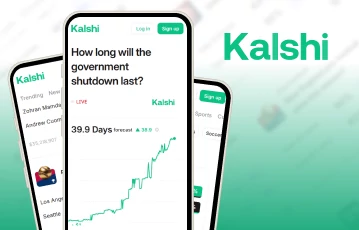
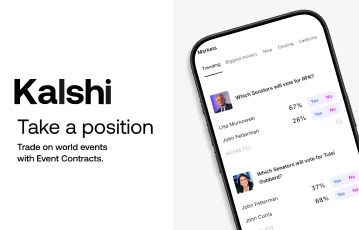
Click the banners on this page to head over to the Kalshi website or mobile app.
-
Click the green “Sign Up” button in the top right corner.
-
Follow the prompts to register via email, Google, or Apple.
-
Provide basic information like your full name, address, and SSN.
-
Upload a copy of your ID to verify your identity.
-
Fund your account using a bank transfer, a card, or crypto.
-
This is the stage where you submit a Kalshi referral code if you have one to unlock the welcome bonus. There is currently no need to enter a code, though.
Finding a prediction market
Once your account is funded, you can now browse the different prediction categories using the available filters. Pick the event you’re interested in and research official data sources tied to the event to give you an informational edge. Also, consider the prevailing contract price, as it shows your potential profits if your prediction is correct. Trading on your mobile from any location is what the Kalshi app is perfect for.
Placing a trade
Once you’re happy with your position, go ahead and select Yes if you think the event will happen. Pick No if you don’t think it’ll occur. You can purchase as many contracts as you want, and they all have a fixed price of between $0.01 and $0.99. You can either buy or sell based on the prevailing price or set a maximum price that you’re happy to pay in case of any shifts. Review the potential profit and hit Confirm once you’re happy with your decision.
Common beginner mistakes to avoid
Getting started on Kalshi is simple, but a few early mistakes can quickly eat into our balance and confidence. The good thing is that most beginner errors are easy to avoid once you know what to watch for.
- Start with trading markets you understand – Jumping into politics, economics, or crypto without background knowledge often turns trading into guessing.
- Holding contracts too long – Waiting until settlement can backfire when prices were favorable earlier, and a smart exit was available.
- Overloading one event – Putting too much money on one prediction increases risk if that single trade goes wrong.
- Ignoring fees – Small trading and processing fees can quietly reduce profits over time.
How profit, loss, and settlement work
What is Kalshi like when it comes to potential trade profits and losses? Here’s what we found.
How returns are calculated
Winning contracts settle at $1 and losing predictions settle at $0. So, if you buy a Yes contract worth $0.70 and the event happens, you get a $0.30 profit. If your prediction goes sideways, you walk away empty-handed. That said, $1 is the maximum gain in this setup. As for maximum losses, anytime you purchase an event contract, you can’t lose more than your initial investment. If you bought a $0.50 contract, you only lose $0.50.
Closing early versus holding
Kalshi predictions are a different ballgame from traditional stock markets. Contracts typically settle in hours or days after the event happens, depending on the market. Closing your predictions early is almost always a smart move at Kalshi. Prices are still relatively favorable before more information comes to light and flips the dynamic. Closing early can lead to higher and more consistent profits than holding out. The latter is quite risky due to market volatility caused by “last-minute surprises”.
Understanding risk
Trading on Kalshi carries risk. There’s always a chance you’re dealing with incorrect forecasts that can overestimate or underestimate demand, leading to significant losses. The only consolation is that you can’t lose more than you put in. Even so, avoid putting all your bank on one event.
How Kalshi fees work
How does Kalshi work concerning fees? The site charges a fee based on the number of contracts you buy and the expected returns. The fee can go as high as 3.5%. Kalshi fees tend to be higher for mid-priced contracts of between $0.40 and $0.60, with $0.50 being the most expensive. We noticed that trading fees are lower for low-priced contracts of $0.01 or $0.05 as well as those pegged at $0.99.
The $0.50 price is the highest because it’s quite risky and reflects greater market uncertainty about whether an event will occur. Naturally, a $0.99 contract shows the market is almost 100% certain the event will happen, so there’s no ambiguity there for Kalshi to work with. The best approach may be to set your own prices and wait for buyers and sellers to come to you. In addition to trading fees, Kalshi charges a 2% processing fee on debit card deposits and withdrawals.
How does Kalshi work pros & cons
It’s important to have a clear understanding of the upsides and downsides to get a well-rounded picture of what Kalshi is.

- Easy onboarding process
- Covers a wide range of prediction markets
- Simple binary Yes/No outcomes
- Regulated and legal exchange platform
- Markets can be volatile
Simple contracts, full regulation, low fees at Kalshi
Now that you know what Kalshi is, don’t let your knowledge of economics, politics, or pop culture go to waste. The regulated exchange platform is open to all traders who wish to predict outcomes for real-world events. It’s simple to join and uses a simple binary Yes/No structure and resolves contracts using clear and transparent rules.
You have loads of markets to pick from and can never lose more than you purchase contracts for. However, responsible bankroll management is a must to survive inevitable bad runs. You can click the banners on this page to sign up with Kalshi.