International NFL Games Are 'Tentpole' Events for Potential Problem Gamblers: Analysis
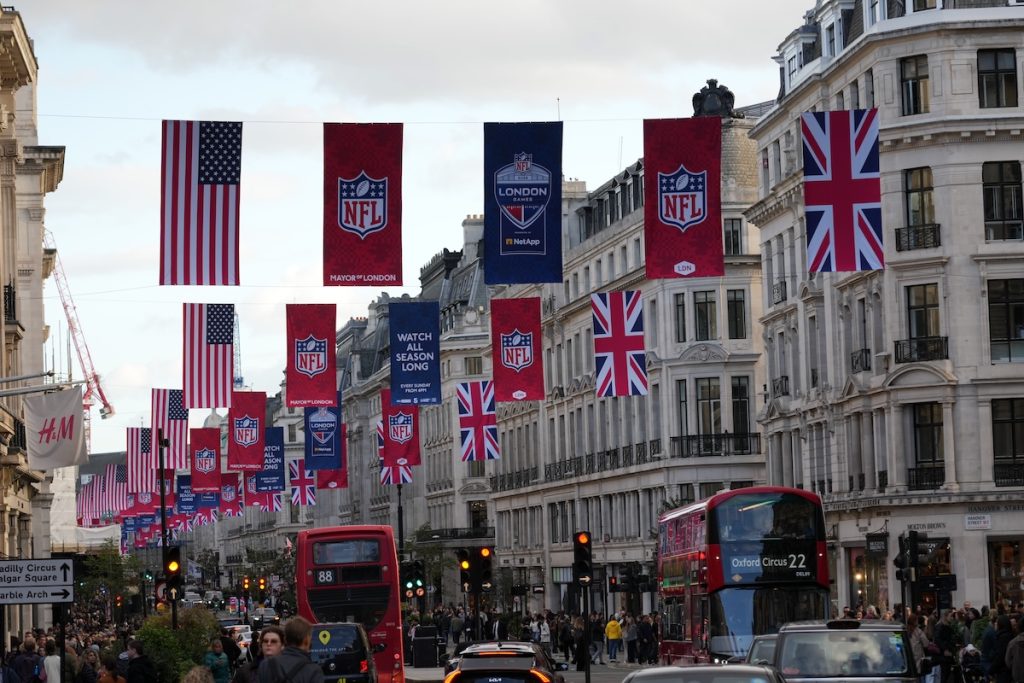
International National Football League games have been seen by the league as a way to expand its global fan base. Local fans view them as a breakfast-hour appetizer for a typical autumn Sunday of viewing, or as an excuse for a football vacation to places like Berlin or Sao Paolo if their team draws one of these yearly junkets.
For at least one mental health specialist, they could also serve as an unlikely starting point for problem gambling. With the communal aspect of these “tentpole events" — such as the World Cup this summer — revealing themselves as wildly popular betting spectacles, Eric Webber, the Senior Behavioral Health Therapist at Caron Treatment Centers, worries that these types of high-profile games could introduce first-time and potential problem bettors to negative proclivities they never knew they had.
“I think there’s interest in the new and the novel. And with the interest in the new and the novel, here's an opportunity to heighten your watching experience by having the betting ability,” Webber said. “From DraftKings' standpoint or whoever else is [offering bets], it makes sense.
“Sure, but I do think there is also that chance that somebody gets caught up in a whirlwind that might be problematic for them.”
Fun Novelty Experiences, But With the Possibility of Problems
Webber doesn’t begrudge fun. He was as bemused as anyone about how German fans traveled the United States following Die Nationalelf and learned they loved ranch dressing. But maybe there is an analogy in the dipping sauce. Too much ranch might not be good. Neither is too many parlays.
“It's silly, it's fun, it's really positive in a time of the world where we had so much negativity to bitch about, something really positive, and so the World Cup, as just an example, is, this feels great for humanity,” Webber noted. “And then for the gambler, or somebody who wants to gamble, you can put five bucks on it and have a good time and be that much more engaged.
“My interest, and I'll hammer this one, my interest is not in, ‘there's a problem with gambling.’ It’s that I deal with problem gamblers. It's, ‘How can we stop that slippery slope from happening?’”
While it is unclear how many World Cup bettors will continue to patronize sportsbooks after the summer event in North America, many new players participated in what Hard Rock officials described to ESPN as the “equivalent of 10 Super Bowls.”
"A sport we were once told Americans would not embrace turned into one for the history books,” Hard Rock Bet SVP of Sportsbook Neil Walsh told ESPN. “ The whole country wanted in."
International Games Meant to Stake Out New Fans in Tough Times
The NFL will play nine international games this season — the next at Wembley Stadium in London with Jacksonville hosting Houston on Oct. 18.
Academia generally coalesces around the idea that 3% of those who gamble will eventually exhibit problematic behaviors. While that remains a minuscule sector of the gambling public, Webber said safeguards should be maintained and strengthened for the protection of all gamblers, particularly young ones or ones that use prediction markets before reaching age 21.
“Maximum number of bets per game or maximum amount of betting per game, whatever those limits need to be,” he said.
While Webber’s observations on tentpole sporting events as triggers are unique within the addictive gambling research and care community, the call for safeguards is universal. Dr. Lia Nower, the director of the Rutgers University Center for Gambling Studies, said that “events like that can introduce people to a new activity which would then add to their overall risk,” but had not seen research to support Webber’s specific hypothesis.
“What the evidence does show is that there is an additive effect to specific gambling-related factors that do increase risk: the more activities you do, the more often you do them, and the more ways you bet (i.e., both online and in land-based venues) the higher the risk,” Nower said in an email. “What we are seeing is adolescents begin with things like bingo, scratch-offs, lottery and then, when they get to be older adolescents, they move to slots, initiate sports wagering, etc.
"As they develop problems, they add activities not to necessarily replace them, such that an average young person with no problems may gamble on two and a high-risk problem person on an average of six activities."
Betting Velocity, Micro Wagers Work for Sportsbooks ... Against Bettors
“Quick hits,” like in-play betting, Webber said, can trigger compulsive activity, a belief that continues to spread, as evidenced by numerous calls nationally to ban the practice in the wake of increases to problem gambling hotlines and sports betting scandals involving these micro wagers.
“From my standpoint, somebody who's going to be prone to be a problem gambler, it's quick fixes, it's quick hits. They make it really easy to just start getting into the deep end,” he said. “The double-edged sword is this great business sense. How do I get somebody interested in coming back and make it as easy as possible? I don't want to make stuff complex because nobody's going to want to engage with that complex.”
The business and marketing dynamic, Webber said, is analogous to industries like liquor or cigarettes, which, over the past 50 years, have been legally limited from advertising in spaces frequented by minors. While these industries might be able to contend with evidence that mainstream media is decreasingly occupied by minors, Webber said the current regulatory framework provides a blueprint. Outcry over the frequency and aggressiveness of sportsbook ads has been a constant rumble since the Professional and Amateur Sports Protection Act was repealed in 2018. Prediction markets, formerly on social media with the help of paid influencers, and notably on television with the recent risque Sydney Sweeney Novig ad, have become masters of letting professional and social media amplify their messaging.
“Why is the drinking age 21? Because we feel like younger people might, we wanna shield them for at least a period of time, right?,” Webber pondered. “Why don't we advertise liquor at certain areas? Why don't we advertise cigarettes at certain things? We put things in place for these businesses to help shield the consumer a certain amount, at least slow them down.”
Advertising Budgets for Gambling Brands Continue Steep Climb
But as evidenced by Novig and recent proclamations by Fanatics CEO and founder Michael Rubin, the push for market share will continue.
Rubin said in a recent call with investors that “Fanatics plans to more than double advertising for its gambling unit to as much as $1 billion in 2027, from $350 million this year.” He added, regarding prediction markets: “FanDuel and DraftKings competed with themselves two years ago. Now they have Fanatics, Kalshi and Polymarket. All the marketing costs are up. Everything is more complicated in this business. All of that said, we ask ourselves: Is this a business that we can be better than the competition long term? The answer is yes."
While the average age of an NFL fan is, anecdotally, in the mid-50s, declining NFL television ratings have spurred movements to retain younger audiences who increasingly consume sports in snippets on mobile devices and via social media.
Anthony Palomba, an assistant professor of business administration at the University of Virginia’s Darden School of Business, said in a February report that sports betting is seen as a way to engage that younger demographic.
“Sports betting helps because you have to bet on a player on a team or bet for a team,” Palomba said in the report, which addressed declining viewership from young people. “That could be the new connective glue.”
-
Sweepstakes Casinos Begin to Pull Back From Oklahoma
-
International NFL Games Are 'Tentpole' Events for Potential Problem Gamblers: Analysis
-

Tilt Rips Launches Limited-Edition VIP Concierge: Premium Racing & Food Experiences
-

Inter Miami vs. New York Prediction, Odds & Picks for Oct. 14: Herons to Secure Big Victory
-
Shohei Ohtani Expected Back in Dodgers Lineup for NLCS Game 3
-
Stars vs. Avalanche Prediction, Odds and Props for Oct. 14: Dallas Gets Revenge