Hard Rock Plays Hard Ball in Florida | Analysis
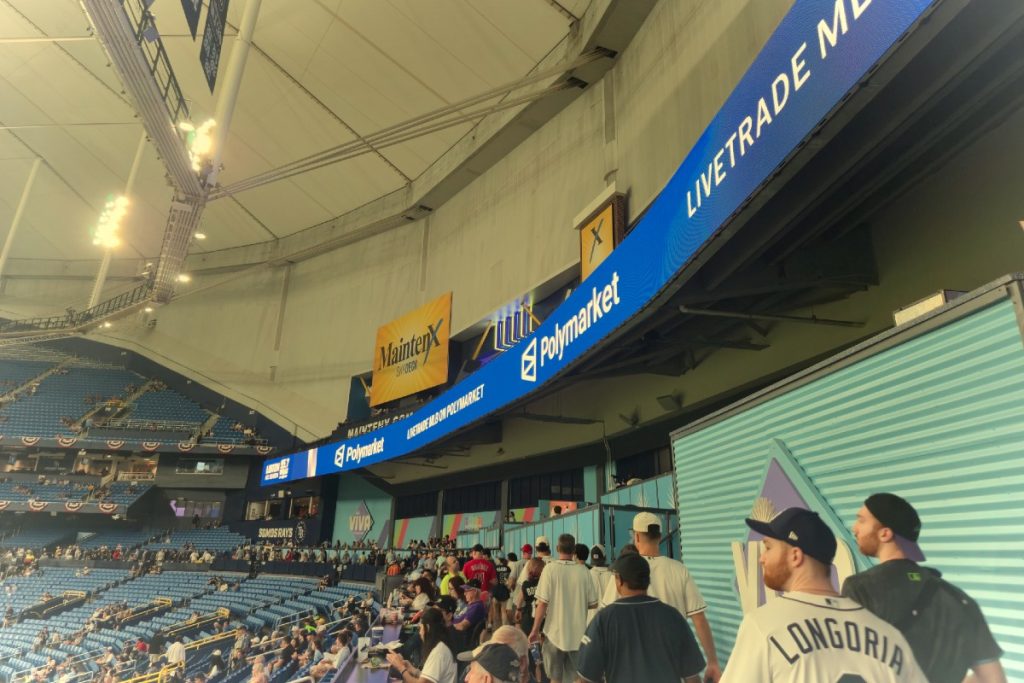
ST. PETERSBURG, Fla. — Two hours before Game 6 of the American League Championship Series, fans jostled for standing-room-only tables along the outfield concourse at Tropicana Field. As the Guardians finished batting practice, the logos of Major League Baseball’s corporate partners began scrolling across the ribbons of video boards on the second-deck facade in left field.
There were 42 of them in all, corporations that had sufficiently invested to become the official this or partner of that with MLB. Food, beer, investment firms, and whatever AbbVie does.
And then there were four noteworthy outliers, gambling or gambling-adjacent outlets: BetMGM, FanDuel, MGM Rewards, and Polymarket.
The permanent Hard Rock billboard, the only gambling company licensed by the state of Florida to offer sports betting here, stood beyond the right-field foul pole. Whether anyone is licensed to offer sports event contracts in Florida or anywhere remains a contentious legal matter.
But the signage was an apt visual metaphor of a conflict where gambling companies continue to make incursions into Florida despite a 2021 Compact that gave the Seminole Tribe exclusivity of the enterprise. No sportsbook has been brazen enough to flout state law here, but prediction markets like Kalshi, Polymarket, DraftKings, and FanDuel continue to offer their wares, arguing in court that the Commodity Futures Trading Commission (CFTC) sanctions them at the federal level and that they fall outside state regulators' purview.
Seminole Outcome Likely Another Tribal Bellwether
As the Rays were in the process of advancing to a third World Series, MLB’s corporate mechanism hard-wired itself to the marketing mechanism of Tropicana Field — as it does with all playoff venues — walking Hard Rock’s competitors into a stadium where they either aren’t legal as sportsbooks or are still defending their prediction platforms in court. The same would be true in Milwaukee, where the National League champion Brewers also reside in a state with only retail sports betting run by tribal entities. And at Dodger Stadium, California has not legalized sports betting in any form.
Florida remains a prize among the three largest states without legal commercial sports betting outside a tribal monopoly. With the Seminole Tribe of Florida running that monopoly, it serves as a bellwether for the future of both tribal and commercial gambling, underscored by its recent lawsuit against DraftKings and co-founder CEO Jason Robins, alleging illegal encroachment on its exclusivity.
This is no surprise considering the tethered nature of the Seminoles’ relationship with the state, Robert Jarvis, a Florida gambling expert and law professor at Nova Southeastern University, told TheLines.
“The Seminoles have been leaning heavily on the state to close down all these channels that they see as illegal, as violative of the compact, and as taking money away from that,” Jarvis said. “And their view is, and they certainly are not wrong about this, that every dollar spent on Kalshi, or on Stake, or at a local gambling arcade, or on a foreign country website, every dollar spent on any of those channels is a dollar that they are not getting.
“And because they are joined at the hip with the state, and the state is joined at the hip with the Seminoles, the Seminoles have pointed out to the state that every time we, the Tribe, don't get a dollar, you, the state … don’t get what you’re supposed to be getting.”
As part of its exclusivity deal, the Seminoles pay the state annual revenue-sharing money that totaled more than $650 million in 2023, according to Hard Rock International Chairman Jim Allen, and is estimated to total $6 billion through 2030.
The United States Supreme Court did not take up a 2024 challenge to the Seminoles’ exclusivity from in-state pari-mutuel outlets. Those same jurists are expected to eventually consider, in 2028, a petition from New Jersey officials asking whether prediction markets are gambling operations that should be regulated at the state level, rather than financial instruments regulated by the CFTC.
Seminoles Strategy Usually Plays Out
In taking umbrage with DraftKings’ all-encompassing “Super App,” which packages sports betting, lottery, online casino, where legal, and predictions, the Seminole suit noted its appeal to young adults.
From the 72-page filing in Broward County, where Hard Rock’s Guitar Hotel is located: “It is no surprise that DraftKings is especially popular with Floridians under twenty-one. They cannot bet on Hard Rock Bet, leaving DraftKings as the only game in town for them.”
Exchanges let users gamble starting at age 18, unlocking a coveted demographic that can’t legally open sportsbook accounts in most states until age 21.
Jarvis believes that the suit against DraftKings will eventually include FanDuel. Together, the companies account for upwards of 80% of the legal sports betting market in the United States, and fund public relations campaigns and ballot initiatives to break the Hard Rock monopoly.
“[This] is really the Seminoles taking matters into their own hands,” Jarvis said. “They have never felt that the state is aggressive enough to close down these alternate channels. Now, one reason, of course, is because the state has lots of other priorities, has only so much in terms of enforcement resources, can only do so much, and so I'm not surprised that the Seminoles decided to bring this lawsuit.
"Another reason to bring this lawsuit, of course, is to remind anyone who might be trying to siphon dollars away from the Seminoles: ‘We're a large, powerful tribe with lots of resources, and we will come after you if you don't cease and desist.’”
Florida Gaming Control Commission Chair Julie Brown acknowledged the Seminole Tribe’s involvement in policing the state gambling economy.
“Obviously,” she said, “we do have a good partnership with the tribe, and so they bring a lot of issues to our attention.”
The illegal online casino market in Florida is believed to currently be worth $4 billion annually.
New Forms of Gambling, New Fronts in Florida
Numerous gambling-related bills failed in Florida’s 60-day legislative session this year, many of which would have codified gray areas in daily fantasy sports regulation and online casinos, but prediction markets did not yet register distress with lawmakers. Minnesota is the only state to ban prediction markets through legislation so far.
In August, Florida Attorney General James Uthmeier issued cease-and-desist orders to sweepstakes casino sites, including Stake, Chumba Casino, LuckyLand, and Global Poker. But prediction markets have not yet been warned.
Brown believes her organization has developed well after being formed in 2021, but said adapting to tech invasions is far more involved than raiding pop-up “arcades” of illegal slot machines, another focus of the FGCC.
“Illegal operators are getting much more sophisticated,” she said. “Just like the products are advancing, technology's advancing and the regulatory market has to advance. And as a state agency, state commission, there are limitations of what you can do.
“I think we're in such a unique position, the way that they created us and combined regulatory and law enforcement in the same commission. So we are trying to stay abreast and also trying to change the laws. You see AI, you see the various actors in a state like Florida where you have almost 24 million [residents], and then we have 100 million plus that visit us every year.”
Long Road to a Big Decision
The Seminole Tribe has a history of patience that has paid off. Handsomely. A hospitality empire that began humbly with the opening of contentious bingo parlors in 1979 grew to enable the purchase of a Hard Rock brand that now touts $8 billion in yearly revenue, according to Forbes. Profit and growth are existential, and achieving them isn't limited to board members or CEOs. The Seminoles are therefore strategic, and while they have absorbed legal defeats, their long-term trajectory has been marked by victories, like their virtual monopoly on gambling in Florida. Eventually, they will ask for the exclusive right to offer online casino gambling in the state.
Jarvis said the current suit was worth it as they await a Supreme Court decision on the legality of prediction markets. And their response.
“There was no downside to bringing this lawsuit,” he said. “I think what we are all waiting for is to see what the U.S. Supreme Court is going to do about the Kalshi lawsuits. I have no doubt that the Supreme Court will grant certiorari, but we're not going to get a decision from the court until 2028.
“So I think the Seminoles just said, ‘What the heck, we will file this lawsuit, put some pressure on DraftKings, get some press reminding people, ‘do not play on these other sites. If you want to bet, you should bet on our site.’”
Jarvis conceded that DraftKings cares “a whit” about the suit. At the NEXTPredict conference in New York on Thursday, Robins said DraftKings was in a “win-win spot” no matter how the court rules on sports events contracts as gambling, because of the company’s diversity and national positioning as a sportsbook.
While the U.S. Court of Appeals for the Third Circuit agreed with Kalshi’s contention that sports events contracts constitute swaps, and granted a preliminary injunction to prevent New Jersey officials from ordering the site to leave the state, the Sixth and Ninth Circuits ruled that states and tribal entities can regulate prediction markets.
So there is much to sort out. This includes conflicts of interest involving Donald Trump Jr., an advisor to both Kalshi and Polymarket.
“If we had a normal Supreme Court, we could confidently predict that the court would reverse the Third Circuit, would affirm the Sixth and the Ninth Circuit, and would say that prediction markets are just gambling, and therefore they're under state control,” Jarvis observed. “But because we don't have a normal Supreme Court, we've got a Supreme Court that does [President] Donald Trump's bidding, and Donald Trump has made it very clear that he wants these prediction markets to be regulated by the CFTC, which really means no regulation at all.”
Gambling industry lobbyist and lawyer Bill Pascrell III agreed with Jarvis’ Supreme Court timeline, saying at the NEXTPredict conference on Thursday expects a "slow roll" by the Supreme Court and no decision within a year.
-
Hard Rock Plays Hard Ball in Florida | Analysis
-
New York Sports Betting Handle for NFL Week 6 Rises 11% YoY
-
Connor Hellebuyck Dealt to Devils
-
NBA Player Props Today: 5 Best Bets for Oct. 23
-
College Football Picks and Parlays for Week 7: The Underdogs Come Through
-
MLB Home Run Props and Predictions Today: Top Player Props for Oct. 23